

Hero banner for all pages except home page
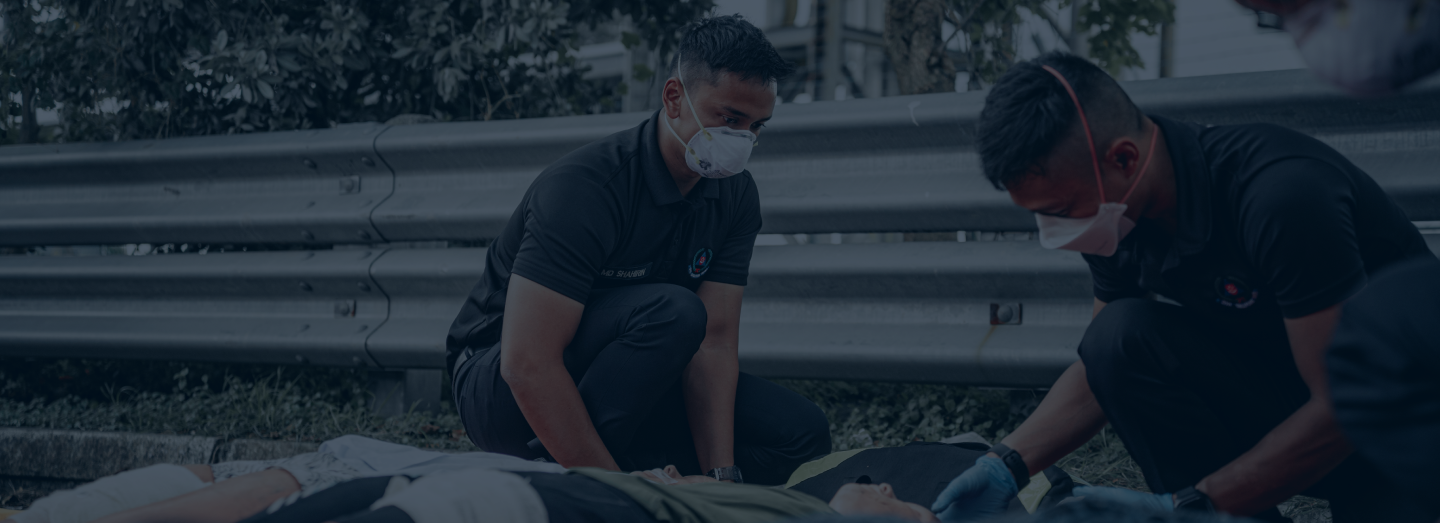
After completing the DART Selection in February, eight SCDF officers began the DART Specialist Course. Over eight weeks, they underwent intensive training to attain the operational competency required of DART Specialists.
Each day began at 5 am with physical training, followed by lessons and scenario exercises that replicated the realities of complex rescue operations. Beyond technical proficiency, the trainees were also trained to operate effectively under pressure.
/p1---cpt-ahmad-webp.webp?sfvrsn=cd92b289_1) CPT Ahmad Faizal Bin Abdul Hanan briefs trainees on the expectations and responsibilities of a DART Specialist. PHOTO: SCDF
CPT Ahmad Faizal Bin Abdul Hanan briefs trainees on the expectations and responsibilities of a DART Specialist. PHOTO: SCDF
“To push trainees beyond their comfort zones, the course difficulty increases progressively,” CPT Ahmad Faizal Bin Abdul Hanan shared. “We curate a training environment that builds their perseverance and mental resilience. This gives them the confidence to make sound decisions while staying mission-focused in high-pressure situations.”
Height Rescue
One key component of the course was height rescue training, where trainees learned various rescue techniques for different scenarios and casualty conditions.
With 11 years of experience in DART, WO2 Muhammad Firdaus Tay Bin Kassim guided trainees through advanced knot craft, anchoring systems, lowering and raising techniques, rappelling, and one-man rescue procedure. Throughout, the instructors emphasised attention to detail and strict adherence to safety protocols.
“No two rescues are the same. Our trainees are taught to anticipate challenges, assess risks, and adapt their strategies accordingly. This ensures that rescues are conducted safely and effectively,” WO2 Firdaus shared.
/p2---rappelling.webp?sfvrsn=db01986f_1) WO2 Muhammad Firdaus Tay Bin Kassim (top left photo) and WO2 Muhammad Fadly Bin Ismail (bottom left photo) guiding trainees to rappel with confidence and precision. PHOTO: SCDF
WO2 Muhammad Firdaus Tay Bin Kassim (top left photo) and WO2 Muhammad Fadly Bin Ismail (bottom left photo) guiding trainees to rappel with confidence and precision. PHOTO: SCDF
/p3---one-man-rescue.webp?sfvrsn=2558e5bb_1) WO2 Firdaus assessing trainees during the one-man rescue exercise, where the rescuer descended from above to secure a suspended “casualty”, before lowering together to the ground floor. PHOTO: SCDF
WO2 Firdaus assessing trainees during the one-man rescue exercise, where the rescuer descended from above to secure a suspended “casualty”, before lowering together to the ground floor. PHOTO: SCDF
/p4---depth-rescue.webp?sfvrsn=cb7b89de_1) In this exercise, SGT2 Muhammad Saifuddin Bin Mohamad Haron (right photo) was lowered from above to secure the “casualty”, before being hoisted back up by his teammates. PHOTO: SCDF
In this exercise, SGT2 Muhammad Saifuddin Bin Mohamad Haron (right photo) was lowered from above to secure the “casualty”, before being hoisted back up by his teammates. PHOTO: SCDF
“I want to inculcate a sense of ownership and responsibility in each DART Specialist. They must always prioritise not only their own safety, but also the safety of their teammates and the casualties,” WO2 Firdaus said firmly. “Speed is important during rescue operations, but safety must always come first. This is the mindset that I want them to have from now on.”
Echoing the same sentiment, trainee SGT2 Muhammad Saifuddin Bin Mohamad Haron said, “The instructors constantly reminded us to stay alert and pay attention to small details, so that we can carry out the rescues safely.”
Water Rescue
The same emphasis on discipline and safety carried into the water rescue component, which covered both surface and underwater rescue techniques.
/p5---surface-water-rescue-4-june.webp?sfvrsn=192cc963_1) During a scenario exercise, trainees conducted a swift rescue of a “drowning casualty”, who was roleplayed by a DART instructor. PHOTO: SCDF
During a scenario exercise, trainees conducted a swift rescue of a “drowning casualty”, who was roleplayed by a DART instructor. PHOTO: SCDF
Explaining underwater search and rescue, LTA Muhammad Tashirin Bin Mohd Tahir said, “We first ascertain when and where the casualty was last seen. DART Specialists will then assess the depth, visibility and current patterns of the water body, and establish the area of operation before commencing search and rescue.”
To locate the casualty, DART Specialists will conduct a search on the water surface and also deploy a remotely operated vehicle to search underwater.
/p6---rov-webp.webp?sfvrsn=b6b0bc8b_1) Controlled remotely from the surface, the remotely operated vehicle uses sonar-imaging technology to locate casualties. This facilitates the search for casualties while ensuring the safety of DART’s divers in low-visibility conditions. PHOTO: SCDF
Controlled remotely from the surface, the remotely operated vehicle uses sonar-imaging technology to locate casualties. This facilitates the search for casualties while ensuring the safety of DART’s divers in low-visibility conditions. PHOTO: SCDF
“Once the casualty’s position is confirmed through visual confirmation or sonar detection, DART’s divers will be deployed to recover the casualty,” LTA Tashirin added.
To add realism and added difficulty to a search operation, blackout masks, which greatly limited vision, were worn by the trainees during their dives to simulate low visibility in murky waters.
“With little to no visibility, trainees must rely on touch, communication with teammates, and spatial awareness to navigate and locate the casualty,” LTA Tashirin shared.
/p7---underwater-rescue.webp?sfvrsn=2bbb9482_1) With blackout masks limiting their vision, trainees were trained to maintain composure and communication with the team to locate and recover the “casualty”. PHOTO: SCDF
With blackout masks limiting their vision, trainees were trained to maintain composure and communication with the team to locate and recover the “casualty”. PHOTO: SCDF
Ropes and other materials were used to simulate common underwater hazards, such as debris, fishing lines, or vegetation. The trainees were taught how to react during potential entanglement scenarios.
“This trains them to remain calm and free themselves with proper disentanglement techniques,” LTA Tashirin explained. “Overcoming these challenges in a controlled but realistic environment gives them the confidence and composure during actual operations.”
/p8---water-rescue-instructors-v2.webp?sfvrsn=1a184075_1) LTA Muhammad Tashirin Bin Mohd Tahir (left) and WO2 Isa Bin Endin (right) conducting a debrief to recap learning points from the water rescue exercises. PHOTO: SCDF
LTA Muhammad Tashirin Bin Mohd Tahir (left) and WO2 Isa Bin Endin (right) conducting a debrief to recap learning points from the water rescue exercises. PHOTO: SCDF
“As an instructor, I constantly remind trainees that the water is not the natural environment for humans. Every time we enter the water, we are operating in a domain that is inherently foreign to the human body, and this must never be taken lightly. DART divers must approach every single dive with confidence and vigilance,” LTA Tashirin said.
SGT2 Saifuddin found the water rescue component one of the most challenging phases of the course.
“There were moments when we were pushed to our physical limits, but support from my coursemates, colleagues, family, and friends kept me going,” SGT2 Saifuddin shared.
“Adiputra and I kept motivating each other since we first started training together for the DART selection. Throughout the course, our beds were side by side in the dorm. After tough days, we would talk things through and encourage each other,” he recalled. “Humour also helped us get through the tougher moments.”
SGT3 Muhammad Adiputra Bin Mohd Jeferee agreed, adding, “The toughest moments eventually became the most memorable, and those shared experiences strengthened our bond.”
For SGT3 Adiputra, the Breathing Apparatus endurance test proved to be his ultimate hurdle.
/p9---ba-endurance-test.webp?sfvrsn=c2bda761_1) During the Breathing Apparatus endurance test, trainees carried a “casualty” and equipment through a series of obstacles, testing their grit and teamwork under physical exertion. PHOTO: SCDF
During the Breathing Apparatus endurance test, trainees carried a “casualty” and equipment through a series of obstacles, testing their grit and teamwork under physical exertion. PHOTO: SCDF
“There were many times I questioned if I should push on,” SGT3 Adiputra recalled. “I kept thinking about my family, especially my two-year-old son. I want him to look up to me and feel proud.”
/p10---adiputra-webp.webp?sfvrsn=a1d94b08_1) SGT3 Muhammad Adiputra Bin Mohd Jeferee (second from left) taking a brief rest during the intense Breathing Apparatus endurance test. PHOTO: SCDF
SGT3 Muhammad Adiputra Bin Mohd Jeferee (second from left) taking a brief rest during the intense Breathing Apparatus endurance test. PHOTO: SCDF
/p11---adiputra-2-webp.webp?sfvrsn=984bb53b_1) With encouragement from his teammates, SGT3 Adiputra (third from left) persevered and completed the Breathing Apparatus endurance test. PHOTO: SCDF
With encouragement from his teammates, SGT3 Adiputra (third from left) persevered and completed the Breathing Apparatus endurance test. PHOTO: SCDF
Road Traffic Accident Rescue
The trainees were also trained to respond to complex road traffic accidents involving overturned vehicles and trapped casualties.
/p12---rta.webp?sfvrsn=1c6a3be8_1) Working as a team, trainees stabilised the “casualty” and removed the vehicle doors, before rescuing the “casualty”. PHOTO: SCDF
Working as a team, trainees stabilised the “casualty” and removed the vehicle doors, before rescuing the “casualty”. PHOTO: SCDF
“We focused on advanced knowledge and techniques, including hazard identification, vehicle construction analysis, casualty management, stabilisation, and casualty extrication techniques,” WO2 Mohd Shahafashah Bin Selamat explained. “This enables trainees to carefully assess the vehicle’s structural weak points and potential risks before extricating casualties with hydraulic or battery-operated rescue equipment.”
/p13---wo2-shahafashah-webp.webp?sfvrsn=290631c9_1) WO2 Mohd Shahafashah Bin Selamat (first from left) and WO2 Muhammad Rasheedh Bin Mohammed Ibrahim (second from left) observing trainees as they extricate the “casualty” from an overturned vehicle. PHOTO: SCDF
WO2 Mohd Shahafashah Bin Selamat (first from left) and WO2 Muhammad Rasheedh Bin Mohammed Ibrahim (second from left) observing trainees as they extricate the “casualty” from an overturned vehicle. PHOTO: SCDF
“Through scenario exercises, the trainees learn how to adapt to dynamic situations, make sound decisions, and conduct rescue safely while prioritising the casualty’s wellbeing,” WO2 Shahafashah added.
The 36-hour Test
The DART Specialist Course culminated in a 36-hour test in the final week. It began with a 21km route march to the Home Team Tactical Centre, where a series of scenario exercises lay in wait for the trainees to test their knowledge and skills.
/p14---ship-rescue-v2.webp?sfvrsn=f1c7c511_1) Under the instructors’ strict supervision, trainees rescued two “casualties” from within a “ship” at the Home Team Tactical Centre. PHOTO: SCDF
Under the instructors’ strict supervision, trainees rescued two “casualties” from within a “ship” at the Home Team Tactical Centre. PHOTO: SCDF
Following the height rescue scenario exercise, trainees were tested on urban search and rescue.
“During the course, the trainees learnt how to identify hazards and assess structural stability, before searching for and extricating casualties trapped under rubble,” CPT Ahmad shared.
Trainees were also introduced to internationally recognised practices and standards, and methodologies established by the International Search and Rescue Advisory Group (INSARAG) for large-scale disasters.
“With systematic search and rescue methods, our DART Specialists can work cohesively with local and international rescuers and maintain operational synergy in disaster environments,” CPT Ahmad added.
/p15---usar-1.webp?sfvrsn=200f5eec_1) The trainees working alongside international rescuers who were attending SCDF’s International Urban Search and Rescue course. Working cohesively with international counterparts is important as DART Specialists will be deployed for overseas humanitarian assistance and disaster relief missions under Operation Lionheart. PHOTO: SCDF
The trainees working alongside international rescuers who were attending SCDF’s International Urban Search and Rescue course. Working cohesively with international counterparts is important as DART Specialists will be deployed for overseas humanitarian assistance and disaster relief missions under Operation Lionheart. PHOTO: SCDF
/p16---usar-2.webp?sfvrsn=5c99b46e_1) Working through the night, trainees rescued a trapped “casualty” from beneath the rubble. PHOTO: SCDF
Working through the night, trainees rescued a trapped “casualty” from beneath the rubble. PHOTO: SCDF
/p17---route-march-back-to-cda-webp.webp?sfvrsn=aa02f89a_1) In the final phase of the 36-hour test, the trainees carried a “casualty” and equipment on a route march back to the Civil Defence Academy. PHOTO: SCDF
In the final phase of the 36-hour test, the trainees carried a “casualty” and equipment on a route march back to the Civil Defence Academy. PHOTO: SCDF
/p18---ringing-of-bell.webp?sfvrsn=7eae4d69_1) Representing the trainees, CPT Ling Hsih Hwa rang the bell to mark the completion of the DART Specialist Course. DART Specialists from DART East Base and DART West Base welcomed the graduating trainees. PHOTO: SCDF
Representing the trainees, CPT Ling Hsih Hwa rang the bell to mark the completion of the DART Specialist Course. DART Specialists from DART East Base and DART West Base welcomed the graduating trainees. PHOTO: SCDF
“Over eight weeks, the trainees developed the confidence and teamwork required for high-pressure situations,” CPT Ahmad said. “Mission success is never based on individual capability, but on mutual trust, discipline, teamwork, and the ability to lead decisively and support the team.”
LTA Tashirin added, “DART Specialists are often deployed to unpredictable situations with challenging conditions. It is crucial that our trainees have the right values and aptitude to carry out their duties with care, professionalism, and integrity.”
Reflecting on their journey, SGT2 Saifuddin and SGT3 Adiputra credited the instructors for shaping their growth throughout the course.
“The instructors constantly gave us constructive feedback,” SGT2 Saifuddin said. “They led by example and instilled in us the values of humility, discipline, and critical thinking. They are people we look up to, and we are very grateful for their patient guidance, which inspired us to keep improving.”
For SGT3 Adiputra, the course altered his perspective on teamwork. “I was used to doing everything myself instead of delegating tasks,” he shared. “But the instructors taught me that leadership also means trusting your team and knowing when to take charge. This is something I will continue to improve on.”
“I knew the course would be difficult. Still, I wanted to push myself because without challenges, there is no growth,” SGT3 Adiputra added. “It feels truly meaningful to complete the course, and I hope my experience encourages others around me, including my son and colleagues, to always challenge themselves.”
/p19---group-photo-webp.webp?sfvrsn=8829cb50_1) The eight graduates (back row) with COL Lok Wee Keong (front row, fourth from right), DART Commander, and LTC Seloterio Euan Izmal Bin Ilyas (front row, fourth from left), Deputy DART Commander, and instructors (front row, from left) CPT Wilson Tan Wei Sheng, WO2 Mohd Shahafashah Bin Selamat, CPT Ahmad Faizal Bin Abdul Hanan, LTA Muhammad Tashirin Bin Mohd Tahir, WO2 Muhammad Firdaus Tay Bin Kassim, and LTA Zaidi Bin Sa'at at the Passing Out Ceremony on 22 May 2026. PHOTO: SCDF
The eight graduates (back row) with COL Lok Wee Keong (front row, fourth from right), DART Commander, and LTC Seloterio Euan Izmal Bin Ilyas (front row, fourth from left), Deputy DART Commander, and instructors (front row, from left) CPT Wilson Tan Wei Sheng, WO2 Mohd Shahafashah Bin Selamat, CPT Ahmad Faizal Bin Abdul Hanan, LTA Muhammad Tashirin Bin Mohd Tahir, WO2 Muhammad Firdaus Tay Bin Kassim, and LTA Zaidi Bin Sa'at at the Passing Out Ceremony on 22 May 2026. PHOTO: SCDF
With the completion of the course, the eight DART graduates will continue to build on their competencies through further training and frontline operations.
“Learning does not end with the course. DART Specialists must continuously sharpen their technical skills and professional judgement,” CPT Ahmad said firmly. “Every graduate must uphold the professionalism, discipline, resilience, and operational mindset to carry out their duties as DART Specialists with pride and care.”
Congratulations to the graduates of the 29th DART Specialist Course!