

Hero banner for How SCDF Trains for HazMat Response
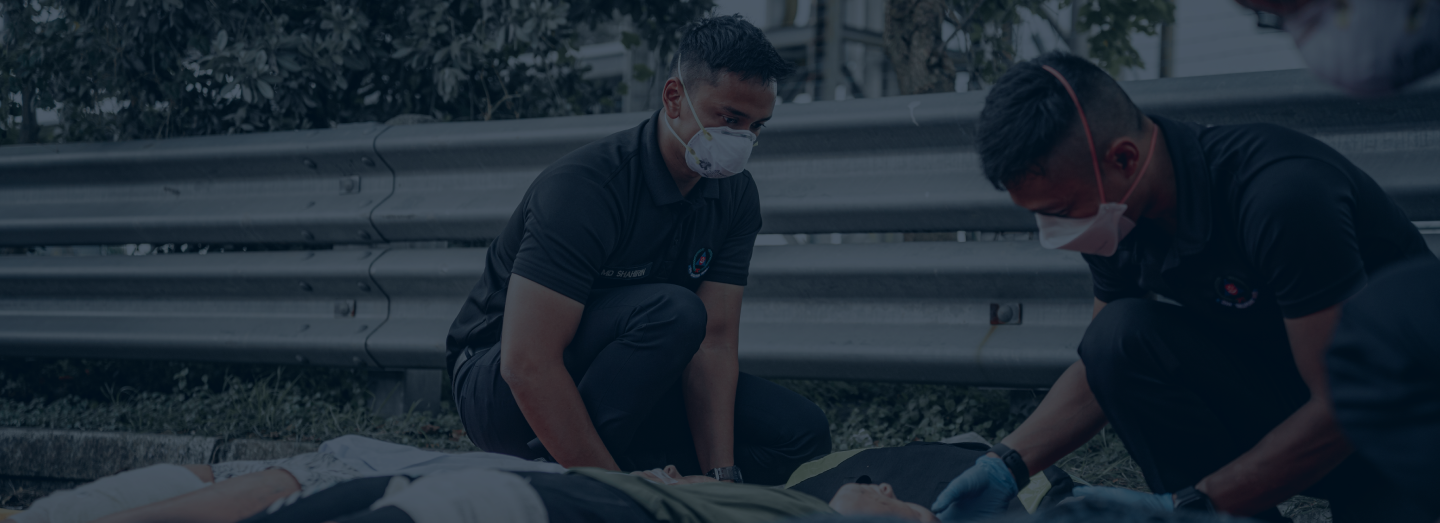
Apart from fighting fires, SCDF firefighters are trained to respond to emergencies involving hazardous materials (HazMat).
Over three weeks in September 2026, trainees from the 37th Rota Commander Course and firefighters from various fire stations attended the HazMat Specialist Course at the Civil Defence Academy, where they learnt to detect and mitigate HazMat.
“Apart from training, we work closely with industry partners and establish systems to strengthen our emergency preparedness for swift and safe mitigation of HazMat incidents,” said LTA Md Shahrel Bin Shawall Hamid, who has been training SCDF officers in HazMat response for over 10 years.
 LTA Md Shahrel Bin Shawall Hamid, a Course Officer at the HazMat and Marine Firefighting Branch, briefing trainees on operating procedures when responding to HazMat incidents. PHOTO: SCDF
Detecting and identifying HazMat
Unlike fires, which are usually visible, HazMat incidents may not be immediately apparent.
“As we may not be able to see or immediately identify the source during a HazMat incident, trainees must assess the situation, interpret information from detectors, and determine their response strategy,” LTA Shahrel said.
“During the course, trainees will learn chemistry and the properties of different substances. Factors such as a chemical’s density, its reactivity with water or heat, and its potential for run-off into drainage systems can affect how an incident is managed,” LTA Shahrel explained.
The trainees are also taught procedures to collect HazMat samples in solid, liquid and gaseous states, mitigate them and carry out decontamination.
 Trainees practising the collection of HazMat samples. They would progress on to complete this task in HazMat protective suits, once they became confident with the procedures. PHOTO: SCDF
 Trainees learning about the equipment and capabilities of the HazMat Control Vehicle, HazMat Support Vehicle, and HazMat Mitigation Vehicle. PHOTO: SCDF
 Trainees understanding the role of the Special Response Unit and its Mass Decontamination Vehicle in SCDF’s HazMat response. PHOTO: SCDF
For OCT Koh Ruey De from the 37th Rota Commander Course, the HazMat Specialist Course helped him to appreciate the diverse nature of HazMat incidents and the specialised equipment used.
Having completed his National Service as a Section Commander at Tampines Fire Station before joining SCDF as a regular officer, OCT Ruey De said the course broadened his operational knowledge and prepared him for various scenarios he may encounter on the frontline.
 OCT Koh Ruey De (left) from 37th Rota Commander Course and SGT2 Muhammad Syukry Salim from Jurong Island Fire Station share their experiences during the HazMat Specialist Course. PHOTO: SCDF
“Initially, I was concerned that the course would be challenging as we had to learn various technical terms and chemicals. There are also many possible developments during a HazMat incident, such as changes in wind direction, so we have to constantly adapt to the situation,” OCT Ruey De said.
“The established procedures and training in the HazMat Specialist Course prepare us for such situations,” he added. “Having protocols such as HAZARD - Hazard Identification, Appreciation of Situation, Zoning, Action for Mitigation, Rescue and Evacuation, and Decontamination - guides us to approach complex situations in a structured manner.”
Mitigating the hazard
Once the HazMat is identified, trainees must determine the appropriate strategy and tactics to contain and mitigate them.
“Using various HazMat equipment, we practised different mitigation methods, such as sealing leaks and transferring HazMat safely,” said SGT2 Muhammad Syukry Salim, a Fire and Rescue Specialist from Jurong Island Fire Station, one of six fire stations specialising in HazMat response.
 LTA Shahrel (top left photo) teaching trainees how to assess hazards and stop leaks with different methods. PHOTO: SCDF
The course also developed the trainees’ physical endurance to operate in various HazMat protective suits.
To acclimatise themselves, trainees carried out a series of tasks while wearing the High Performance Suit and T-suit.
“Wearing the suits made me acutely aware of the increased physical demands and reduced mobility, both of which need to be factored in when carrying out tasks,” SGT2 Syukry said.
 Trainees carrying out a series of tasks at the Civil Defence Academy in the Nuclear, Biological and Chemical suit. PHOTO: SCDF
 Trainees in High Performance Suit (first from right) and T-suit (first and second from left) carry hoses within the Home Team Tactical Centre. They are accompanied by their buddies and instructors to ensure their safety. PHOTO: SCDF
Decontamination
Apart from HazMat mitigation, casualties exposed to HazMat must be promptly evacuated and decontaminated.
SCDF fire engines are equipped with decontamination showers to decontaminate casualties quickly, increasing their chances of survival.
 LTA Shahrel and his colleagues demonstrating the setup of the decontamination corridor, which involves the Portaflex (top photos) and decontamination pit (bottom photos). PHOTO: SCDF
When exiting the affected area, trainees in High Performance Suit, T-suit, and firefighting gear undergo wet decontamination by going through the Portaflex.
Trainees in the Nuclear, Biological, and Chemical suit will go through dry decontamination using Fuller’s earth, a specialised clay material that can absorb contaminants.
Putting their skills to the test
In the final week of the course, the trainees underwent the HazMat Specialist Certification Test, followed by a series of simulated exercises, for a comprehensive assessment of their knowledge in HazMat response.
 The HazMat Specialist Certification Test comprises theory and practical components. Trainees must be proficient in collecting HazMat samples and various mitigation techniques. PHOTO: SCDF
Sharing more about how the instructors plan the simulated exercises, LTA Shahrel said, “We develop scenarios based on case studies from local and overseas incidents. I also speak with SCDF HazMat Specialists to gain insights from their frontline experience and keep up with the latest developments in HazMat response.”
“These are adapted to enhance realism to the simulated exercises and test trainees’ ability to assess information, strategise, and adapt their response as the situation develops,” he added.
During a simulated exercise of a toxic industrial chemical incident, OCT Ruey De was appointed as the Ground Commander.
“Being the Ground Commander allowed me to experience and react to the many ways an incident could unfold. As the situation evolved, we had to carry out multiple tasks concurrently to evacuate “casualties”, mitigate the hazard, and conduct decontamination. I had to constantly assess and adapt our response, while keeping my crew updated on our course of action,” OCT Ruey De shared.
 The simulated exercises test the trainees on their assessment of the situation, detection and identification of HazMat, mitigation methods, management of “casualties”, and decontamination. PHOTO: SCDF
 Water is used to disperse “chemical vapour” and reduce hazards for trainees as they mitigate the “leak”. PHOTO: SCDF
“My first instinct was to mitigate the hazard quickly and rescue the “casualties”. However, the training taught me that we must understand what we are dealing with before committing the crew into the affected area,” OCT Ruey De said.
 In another simulated exercise at the Civil Defence Academy, trainees collected liquid and solid HazMat samples, while evacuating and decontaminating “casualties”. PHOTO: SCDF
To ensure a well-rounded learning experience, trainees rotated between different roles across the simulated exercises.
“The insights and experiences shared by the instructors, alongside the hands-on sessions gave us a greater appreciation of SCDF’s HazMat response capabilities and a deeper understanding of the operational procedures,” SGT2 Syukry said.
Through the simulated exercises, instructors also assess how well trainees applied their knowledge while working as a team.
One of the most visible areas of growth, LTA Shahrel said, is the trainees’ communication and teamwork.
“By the end of the course, the trainees not only communicate more clearly with one another, but also become more proactive in reminding each other of their tasks and supporting their teammates,” he said.
Beyond operational skills, LTA Shahrel hopes that his trainees would develop the mindset required of a HazMat Specialist – remaining composed, maintaining a sense of urgency, and applying critical thinking as circumstances change.
Above all, he emphasises being a lifelong learner to keep up with new technologies and developments.
“A HazMat Specialist must have the knowledge and competency to develop an effective response and mitigation plan. Whether in training or during operations, we must do it right the first time,” LTA Shahrel said.
For him, seeing trainees put what they have learnt into practice is one of the most fulfilling aspects of being an instructor.
“As an instructor, I feel happy when I can make complex topics easier for my trainees to understand. Seeing the trainees demonstrate the knowledge and skills that we have shared, while keeping themselves safe during operations, gives me a sense of fulfilment,” LTA Shahrel said with a smile.
 (From left) HazMat instructors LTA Zainal Abidin Bin Amat, LTA Md Shahrel Bin Shawall Hamid, SGT Chan Jia Wei Marcus, SGT Syed Haider Al - Haddad, SGT Yogen Tishawnn S/O Sivakumaren, with 37th Rota Commander Course instructors SGT Ang Jie Han, LTA Mohamed Saiful bin Mohamed Salleh, and COSEM instructor SCS Ab Latif Bin Raji. PHOTO: SCDF